Backup storage type#
VM Backup is a long-term storage of VM snapshots in reliable and cost-effective storage for further data recovery from stored Restore Points.
Although Hystax Disaster Recovery supports advanced retention policies, long-term storage of multiple restore points can be expensive. This is because achieving a minimal RTO requires storing replicated data on cloud-native block devices (e.g., EBS volumes, Cinder volumes, and their snapshots), which:
- Are relatively expensive
- Are charged based on provisioned size
- May incur snapshot charges based on the provisioned size of the source volume
For more cost-effective storage when using Hystax Disaster Recovery for VM backup, an alternative storage option is available. Instead of block devices, replicated data can be stored in object or file storage, such as S3-compatible storage, Azure Blob Storage, or Unix and Windows shares.
You can select an object or a file storage for replication on cloud connection form:
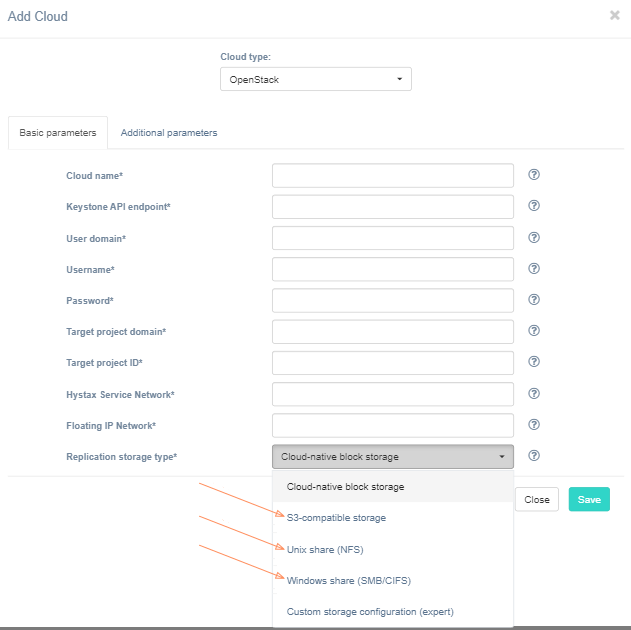
Select 'S3-compatible storage (S3)', 'Azure Blob storage (Blob)', 'Unix share (NFS)' or 'Windows share (SMB/CIFS)' as 'Replication storage type' and enter storage connection credentials to keep data instead of cloud-native block storage.
All other functionality of replication/recovery is similar to the Disaster Recovery case.
Object storage#
In case of object storage ('S3-compatible storage' or 'Azure Blob storage') greater efficiency is achieved through deduplication in the storage system, the ability to store a longer history of recovery points. However, the drawback of storing replicated data in object storage is longer RTO. When Hystax Disaster Recovery recovers VM from object storage, it adds disk render operation, which copies data from object storage to block devices, to usual operations performed during recovery. This operations linearly depends on data size in Restore Point and network bandwidth between storage, Hystax Disaster Recovery Controller and target cloud.
For each Restore Point, Hystax Disaster Recovery creates the following objects in the object storage:
- data objects: at least one per volume of replicated machine. Data object for disk can be split to objects by 50 GB
- Restore Point metadata object: sqlite database which holds block mapping
The described storage scheme has provided the following:
- storage is charged by consumed space for replicated data
- object storage is less expensive than block storage