

Table of contents
- What is a sovereign cloud, and what is it not?
- What is data sovereignty, and how does it differ from data residency and data localization?
- The three layers of sovereignty: data, operational, technical
- The rules driving sovereign cloud in Europe
- EU sovereign cloud providers: five categories
- Moving workloads into a sovereign cloud
- Backup, disaster recovery, and the exit plan inside one jurisdiction
A sovereign cloud is cloud infrastructure where data, operations, and the technology stack fall under the laws of a single jurisdiction, so no foreign authority can compel access.
This guide is for infrastructure teams that need to move workloads into such a cloud and protect them there without the data leaving the jurisdiction.
Key takeaways
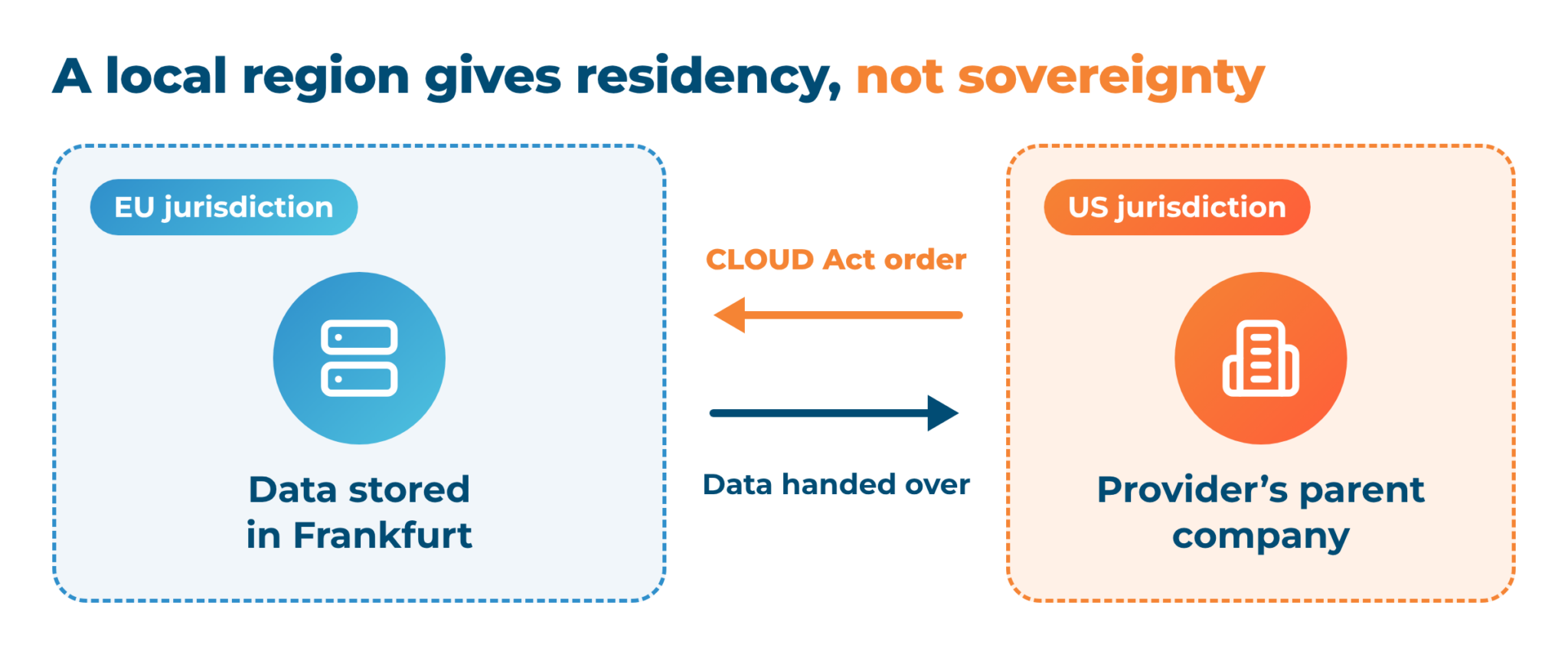
- A local region gives data residency. Who can demand access depends on the operator’s jurisdiction.
- Sovereignty covers three layers: data, operational, and technical.
- The DPF makes personal data transfers to certified US companies lawful today, but it does not limit the CLOUD Act.
- Backups, DR sites, and migration traffic face the same requirements as production data.
What is a sovereign cloud, and what is it not?
- A local region of a US hyperscaler. The servers may stand in Frankfurt, yet the operator stays subject to US law. Under the CLOUD Act (18 U.S.C. § 2713), a provider subject to US jurisdiction must, under a valid US legal order, disclose data in its “possession, custody, or control” wherever that data is stored.
- Encryption on its own. If the provider holds the keys or processes data in clear text, it can still be compelled to hand it over. Bring-your-own-key (BYOK) still places the key in the provider’s key management service. Hold-your-own-key (HYOK) and confidential computing narrow the gap further, but none of them changes the operator.
- A European logo on the invoice. A European reseller of a non-EU platform can still rely on that vendor for software, updates, and support from third countries.
What is data sovereignty, and how does it differ from data residency and data localization?
Data sovereignty means data is governed only by the laws of the jurisdiction it belongs to, and no foreign authority can compel access to it.
Data sovereignty, data residency, and data localization are often used as synonyms, but each guarantees something different.
| Term | What it guarantees | What it does not guarantee | Typical use |
|---|---|---|---|
| Data residency | Data is stored in a chosen country or region | Protection from foreign legal access; local control of operations | Customer contracts, latency, internal policy |
| Data localization | The law requires data to stay within borders | That the operator is local or that foreign laws do not reach it | Data covered by sector or national rules |
| Data sovereignty | Data is subject to one jurisdiction, with no foreign compelled access | Control over operations or the technology stack | Personal data, regulated and sensitive workload |
| Digital sovereignty (operational and technical) | Control over staff, operations, supply chain, and technology | Where a specific dataset is stored | Critical infrastructure, public-sector procurement |
Data sovereignty vs data residency vs data localization
The three layers of sovereignty: data, operational, technical
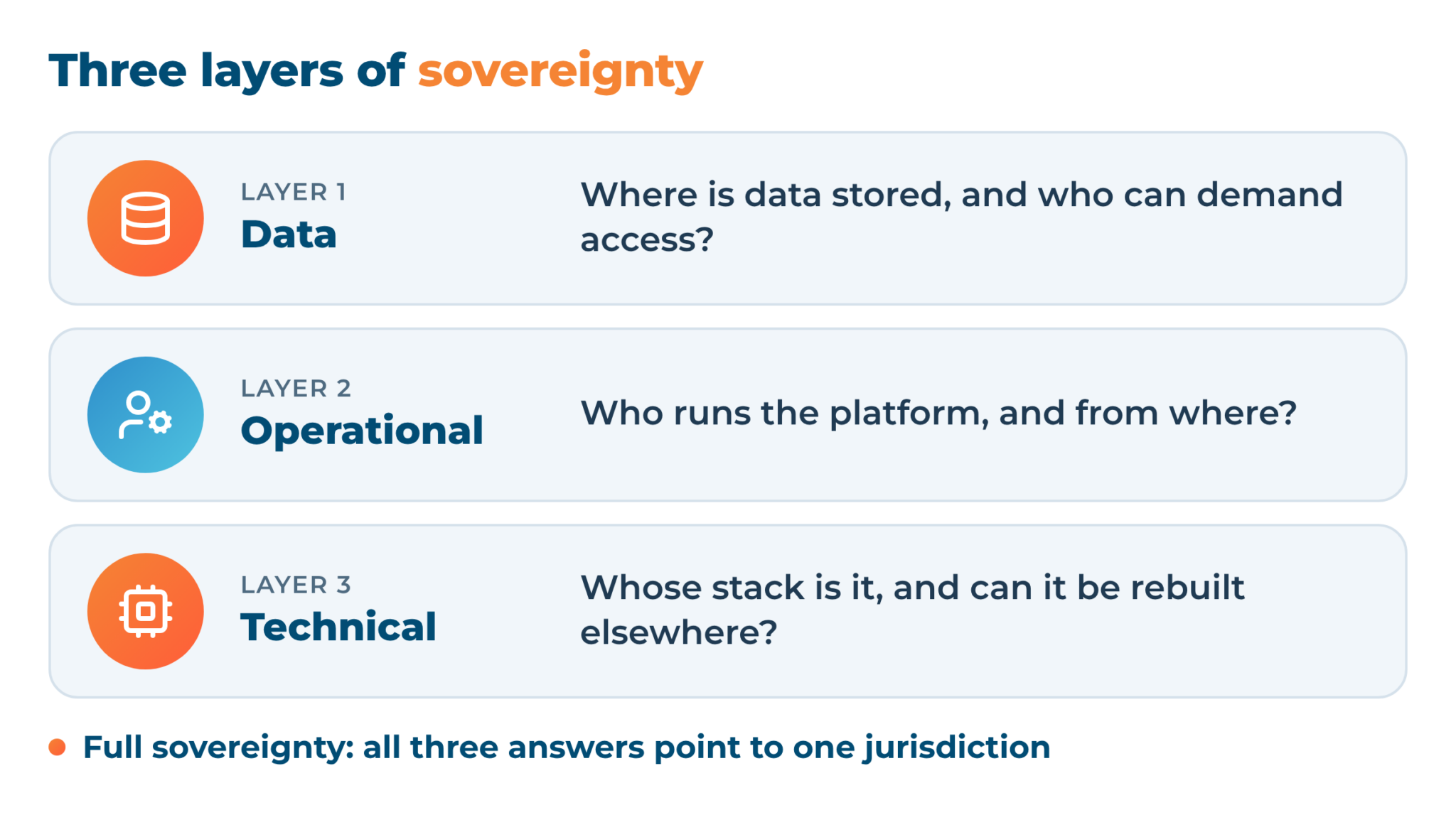
| Layer | Question it answers | How it is checked | What breaks it | Framework objectives |
|---|---|---|---|---|
| Data | Where is data stored, and who can demand access? | Data location, the operator's legal seat, data processing agreement (DPA), key management | A parent company under foreign law; provider-held keys | SOV-2 Legal & Jurisdictional, SOV-3 Data & AI |
| Operational | Who administers the platform, and from where? | Staff location, support model, access logs | Admin access or support from third countries | SOV-4 Operational |
| Technical | Whose stack does it run on, and can it be rebuilt elsewhere? | Licenses, open standards, supplier dependencies | A proprietary platform from a single non-EU vendor | SOV-5 Supply Chain, SOV-6 Technology |
Three layers of sovereignty mapped to the Cloud Sovereignty Framework
Three objectives do not map to a single layer: strategic (SOV-1), security and compliance (SOV-7), and environmental sustainability (SOV-8).
Open source mainly strengthens the technical layer. Different providers or in-house teams can run OpenStack and KVM, reducing vendor lock-in.
The rules driving sovereign cloud in Europe
Legal status last reviewed: November 19, 2026.
Data transfers and foreign access
Resilience and portability
Sovereignty as a procurement requirement
EU sovereign cloud providers: five categories
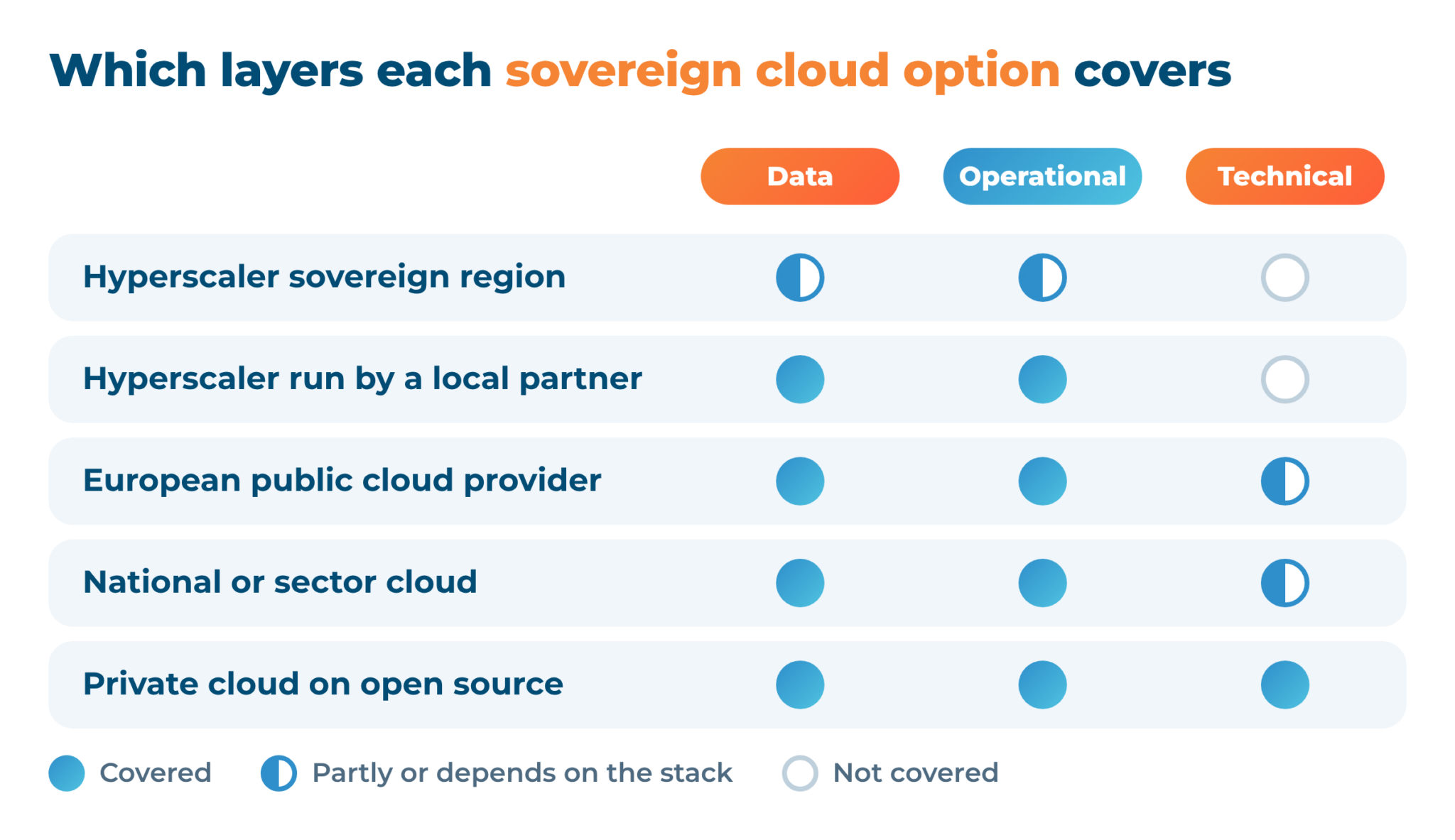
| Category | What it is | Layers it can cover | Typical limit |
|---|---|---|---|
| Hyperscaler sovereign region | EU region of a non-EU provider with extra controls | Data (residency only), part of operational | The owner remains under foreign jurisdiction |
| Hyperscaler cloud run by a local partner | Non-EU technology operated by an EU-controlled company | Data, operational | Dependence on the non-EU stack and its updates |
| European public cloud provider | EU-based provider on its own infrastructure | Data, operational, often technical | Smaller service catalog; software origin varies |
| National or sector cloud | Cloud built for a government or an industry | Data and operational; technical depends on the stack | Limited access and scale |
| Private cloud on open source | Own OpenStack or KVM platform in own or colocated data centers | All three | The team runs and staffs it |
Categories of sovereign cloud offers in the EU
European cloud providers in the third category include IONOS, OVHcloud, Scaleway, STACKIT, and T Cloud Public from T-Systems. Gaia-X and the provider association CISPE work on shared rules for the sector.
Moving workloads into a sovereign cloud
A sovereign cloud migration follows the usual stages, with one extra check at each: where the data goes. When workloads leave a hyperscaler for the team’s own private cloud, the move is also a cloud repatriation.
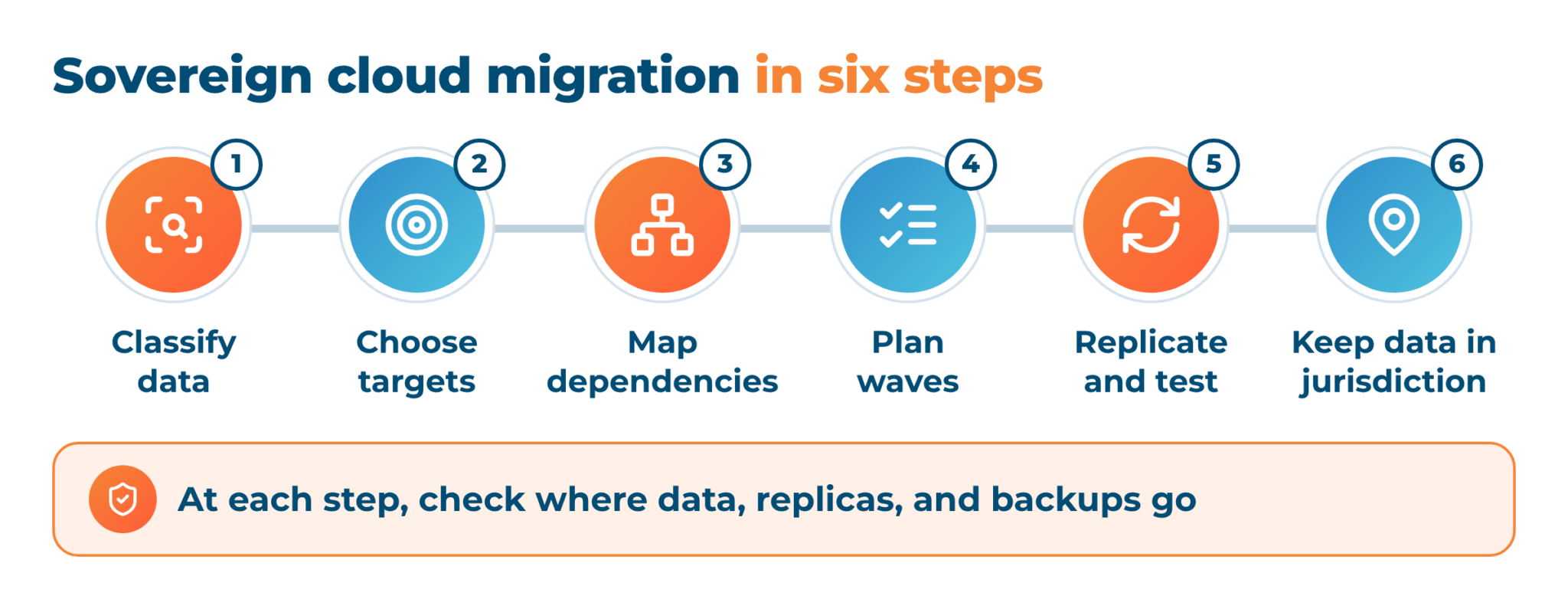
- Inventory and classify data. Which workloads hold personal, regulated, or critical data, and which rules apply.
- Choose the target per class. Each class gets a provider category that covers the sovereignty layers it needs.
- Map dependencies. Applications, databases, identity, DNS, licenses, and external SaaS calls that could send data out.
- Plan migration waves. Less critical systems move first, then core ones once tests pass.
- Reduce downtime. Replicating running machines and testing in an isolated network shrink cutover to a short window.
- Keep data in the jurisdiction during the move. Replication traffic, staging storage, temporary snapshots, and backups created during migration all count.
Get a demo of Hystax Platform – live VM replication into STACKIT or private OpenStack, unlimited test migrations, and a 1–3 minute average cutover.
Thank you for your request!
We will be in touch soon.
Backup, disaster recovery, and the exit plan inside one jurisdiction
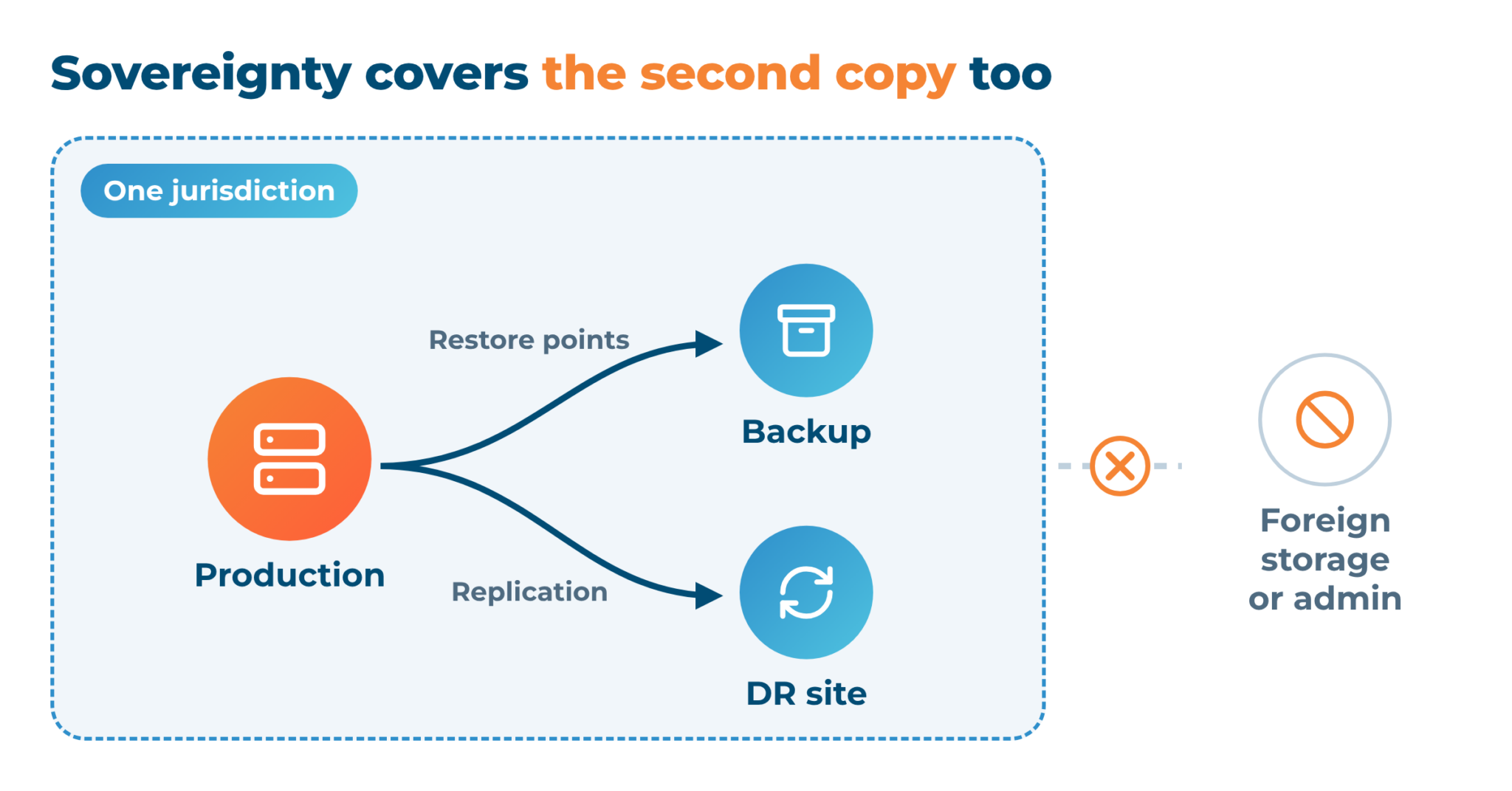
Sovereignty requirements apply to the second copy of the data, too. Backups in a foreign provider’s storage, or a DR site run from a third country, reopen the gaps at the data and operational layers.
Book a DR demo of Hystax Platform: STACKIT as the DR site, failover drills in an isolated network, and immutable backups with S3 Object Lock
Thank you for your request!
We will be in touch soon.
Frequently asked questions
What is a sovereign cloud?
A sovereign cloud is cloud infrastructure where data, operations, and the technology stack fall under the laws of one jurisdiction, so no foreign authority can compel access. In the EU, demand comes from GDPR, exposure to the CLOUD Act, DORA, the Data Act, and public procurement rules.
Data sovereignty vs data residency: what is the difference?
Data residency describes where data is physically stored. Data sovereignty means the data is governed only by the laws of one jurisdiction and cannot be accessed through foreign legal orders. Data stored in Germany by a provider under US law has residency in Germany, but not full sovereignty.
Does a local region make a hyperscaler sovereign?
No. It provides data residency, but the operator, its parent company, and the technology stack can still sit under foreign jurisdiction. Customer-held keys or a local operating partner reduce risk at the data and operational layers, but they don't remove it.
Does the CLOUD Act apply to EU data?
Yes, when a provider subject to US jurisdiction holds it. The CLOUD Act requires such providers to disclose data in their possession, custody, or control regardless of location. The EU-US Data Privacy Framework governs personal data transfers and does not limit the CLOUD Act.
Is the EU-US Data Privacy Framework still valid?
Yes, as of November 19, 2026. The General Court upheld the framework on September 3, 2025, in Case T-553/23. An appeal, Case C-703/25 P, is pending before the Court of Justice. If the Court of Justice annuls the framework, transfers to the US will need other safeguards, such as standard contractual clauses backed by a transfer impact assessment.
Do backups have to stay in the same jurisdiction?
For workloads under sovereignty requirements, yes. A backup or DR copy holds the same data. If it sits with a foreign provider or is managed from a third country, it faces the same foreign access the primary environment avoids. Backup storage, the DR site, and their administration all stay in scope.
How do you avoid lock-in in a sovereign cloud?
Sovereignty does not prevent lock-in, so plan for portability from the start. Use open-source stacks such as OpenStack and KVM, keep data and VM images in portable formats, and limit proprietary managed services. Write an exit plan and test it by replicating workloads to a second environment. The EU Data Act also gives customers the right to switch providers.