Whitepaper 'FinOps and cost management for Kubernetes'
Please consider giving OptScale aStar on GitHub, it is 100% open source. It would increase its visibility to others and expedite product development. Thank you!
Meet Hystax atCloudFest 2026 (Rust, Germany | March 23–26) to discuss mass migrations from VMware and DR & Backup solutions — Main Hall, Booth R28.
Ebook 'From FinOps to proven cloud cost management & optimization strategies'
OptScale FinOps
OptScale — FinOps
FinOps overview
Cost optimization:
AWS
MS Azure
Google Cloud
Alibaba Cloud
Kubernetes
MLOps
OptScale — MLOps
ML/AI Profiling
ML/AI Optimization
Big Data Profiling
OPTSCALE PRICING
cloud migration
Acura — Cloud migration
Overview
Database replatforming
Migration to:
AWS
MS Azure
Google Cloud
Alibaba Cloud
VMWare
OpenStack
KVM
Public Cloud
Migration from:
On-premise
disaster recovery
Acura — DR & cloud backup
Overview
Migration to:
AWS
MS Azure
Google Cloud
Alibaba Cloud
VMWare
OpenStack
KVM

Disaster Recovery vs. DRaaS: which model to choose

DR vs. DRaaS

Table of contents

In today’s IT landscape, downtime is no longer just an operational inconvenience — it’s a direct business risk. According to the IBM Cost of a Data Breach Report, the average cost of a data breach reached $4.45 million globally in 2025, underscoring their financial impact.

At the same time, research from the Uptime Institute shows that over 60% of outages cost more than $100,000, and 15% exceed $1 million, making downtime one of the most expensive risks for modern businesses.

Cyber threats are also becoming more expensive to contain. Cybersecurity Ventures projects that global ransomware damage costs will reach about $275 billion annually by 2031, with ransomware attacks occurring every 2 seconds.

As a result, organizations are rethinking how they approach resilience — and one of the most common questions today is:

“Should we build traditional Disaster Recovery, or adopt DRaaS?”

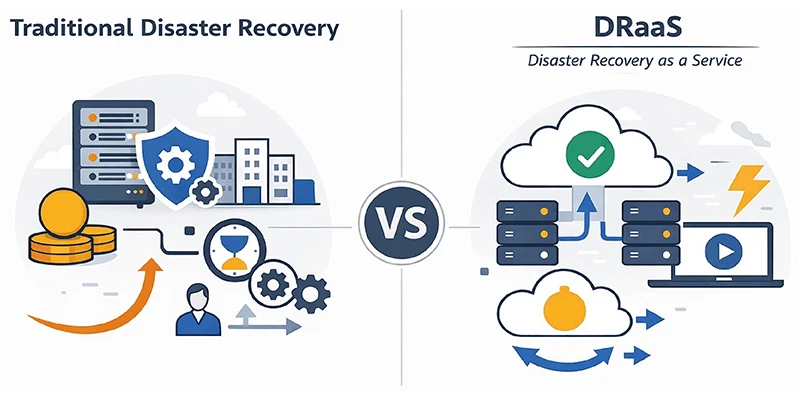
This is where the comparison of disaster recovery vs. DRaaS becomes critical. While both approaches aim to ensure business continuity, they differ significantly in cost structure, operational complexity, and scalability.

In this article, we’ll break down:

  • What traditional disaster recovery is (briefly)
  • What DRaaS (Disaster Recovery as a Service) actually means
  • Key differences in the DR vs. DRaaS model
  • Real-world decision criteria
  • A side-by-side comparison table

The core difference between BCP and DRP

Disaster Recovery (DR) is a strategy that enables organizations to restore IT systems, applications, and data after a disruption.

Traditionally, this involves:

  • Secondary data centers or colocation facilities
  • Backup infrastructure (servers, storage, networking)
  • Replication tools and failover orchestration
  • Internal teams responsible for setup, testing, and execution

This model is often referred to as self-managed or managed disaster recovery, depending on whether internal teams or external providers operate the infrastructure.

Key characteristics of traditional DR:

  • Infrastructure is owned or reserved by the company
  • High upfront capital expenditure (CapEx)
  • Requires continuous maintenance and testing
  • Full control over configuration and policies

While this approach offers flexibility, it also introduces operational overhead and complexity — especially for distributed or hybrid environments.

How DRaaS works in modern IT environments

DRaaS (Disaster Recovery as a Service) is a cloud-based model where a third-party provider delivers disaster recovery capabilities as a managed service.

Instead of building and maintaining DR infrastructure, organizations:

  • Replicate workloads to a provider’s cloud
  • Automate failover and failback processes
  • Pay based on usage or subscription

In essence, cloud disaster recovery becomes an on-demand service rather than a capital-intensive project.

Core components of DRaaS:

  • Continuous data replication to the cloud
  • Automated orchestration of recovery processes
  • Testing and compliance tools
  • Provider-managed infrastructure and updates

This model aligns with broader trends toward cloud adoption and service-based IT consumption.

Disaster Recovery vs. DRaaS — what’s the core difference?

At a high level, the difference between DRaaS vs. Disaster Recovery comes down to ownership and responsibility.

  • Traditional DR → You build and manage everything
  • DRaaS → A provider delivers and operates the service

But in practice, the differences are more nuanced. Let’s see the comparison table.

Comparison table: DR vs. DRaaS

To better understand the differences between Disaster Recovery vs. DRaaS, the table below highlights how these approaches compare across key operational and cost-related factors.

Aspect Traditional Disaster Recovery Disaster Recovery as a Service
Infrastructure Owned or leased by the company Provider-managed cloud infrastructure
Cost model High CapEx + ongoing OpEx Subscription/pay-as-you-go (DRaaS cost)
Deployment time Weeks to months Hours to days
Scalability Limited, requires planning Elastic and on-demand
Maintenance Internal or outsourced (managed disaster recovery) Fully handled by the provider
Testing Manual, often infrequent Automated, regular
Failover Complex, manual, or semi-automated Automated orchestration
Use cases Large enterprises, strict compliance SMBs, cloud-native, hybrid IT

DRaaS Benefits: why companies are moving to service-based recovery

The adoption of Disaster Recovery as a Service is accelerating — and not just among startups.

Here are the key DRaaS benefits driving this shift:

1. Lower upfront investment

Traditional disaster recovery requires duplicating infrastructure — including servers, storage, networking, and data center space — which leads to significant capital expenses.

With Disaster Recovery as a Service, companies shift to a predictable operational model, paying only for the resources they actually use while avoiding overprovisioning.

2. Faster deployment

Building a traditional DR environment can take weeks or even months due to procurement, setup, and configuration.

In contrast, DRaaS solutions can be deployed in days, allowing organizations to achieve protection much faster and reduce the window of vulnerability.

3. Built-in automation

Modern DRaaS platforms are designed with automation at their core, minimizing manual intervention and reducing the risk of human error.

Capabilities typically include automated failover and failback, predefined runbooks, and non-disruptive testing — ensuring that recovery processes are consistent, repeatable, and reliable.

4. Scalability

As infrastructure grows, traditional DR requires additional hardware, capacity planning, and ongoing investment.

DRaaS, on the other hand, provides elastic scalability, allowing organizations to protect new workloads instantly without purchasing or configuring additional infrastructure.

5. Reduced operational burden

Managing traditional DR environments requires continuous monitoring, maintenance, updates, and regular testing — all of which consume valuable IT resources.

With DRaaS, these responsibilities are largely handled by the provider, enabling internal teams to focus on innovation and core business priorities instead of maintaining backup infrastructure.

DRaaS cost vs. traditional DR: what’s more economical?

One of the most important factors in the disaster recovery vs. DRaaS discussion is cost.

Traditional DR costs include:

  • Hardware and infrastructure
  • Data center space and power
  • Licensing
  • Staff and maintenance
  • Testing and upgrades

DRaaS cost structure:

Subscription fees

Most DRaaS (Disaster Recovery as a Service) providers offer subscription-based pricing that includes platform access, orchestration, and management capabilities.

This creates predictable monthly or annual costs, making budgeting easier compared to large upfront investments in traditional disaster recovery.

Storage and replication usage

Costs are typically based on the amount of data replicated and stored in the provider’s infrastructure. Efficient data compression, deduplication, and tiered storage (e.g., object vs. block) can significantly reduce overall DRaaS cost, especially for large environments.

Compute costs during failover

In many DRaaS models, compute resources are only fully utilized — and billed — during actual failover or testing scenarios. This “pay-as-you-recover” approach helps organizations avoid paying for idle infrastructure while still ensuring rapid recovery when needed.

While DRaaS may appear as an ongoing expense, it often reduces the total cost of ownership (TCO), especially for companies that:

  • Don’t frequently use DR infrastructure – traditional DR environments often remain idle but still require full investment and maintenance, whereas DRaaS charges are aligned with actual usage.
  • Want to avoid overprovisioning – DRaaS eliminates the need to size infrastructure for peak scenarios in advance, reducing wasted capacity and unused resources.
  • Need flexible scaling – As workloads grow or change, DRaaS allows organizations to scale protection up or down without additional hardware purchases or long procurement cycles.

When traditional Disaster Recovery still makes sense

Despite the advantages of DRaaS, traditional DR is not obsolete.

It may be the right choice if:

  • You operate in highly regulated industries (e.g., finance, government)
  • You require full physical control over infrastructure
  • Latency or data sovereignty constraints are strict
  • You already have high sunk costs in DR infrastructure

In these cases, managed disaster recovery can serve as a hybrid approach — combining internal control with external expertise.

When DRaaS is better fit

When DRaaS is the better fit

DRaaS vs. Disaster Recovery is not a one-size-fits-all decision, but DRaaS is typically a better option when:

1. You’re adopting a cloud or hybrid infrastructure

DRaaS naturally integrates with cloud environments.

2. You need fast time-to-protection

Startups and growing companies benefit from rapid deployment.

3. You want predictable costs

Subscription-based pricing simplifies budgeting.

4. Your IT team is resource-constrained

DRaaS reduces operational complexity.

5. You need frequent testing and compliance

Automated testing improves reliability and audit readiness.

Cloud Disaster Recovery and hybrid models

An important nuance in the DR vs. DRaaS discussion is that many organizations today adopt hybrid models.

For example:

  • On-premises workloads replicated to the cloud

Organizations keep their primary infrastructure on-premises while continuously replicating data and workloads to a cloud environment for recovery purposes. This approach allows businesses to modernize their cloud disaster recovery strategy without fully migrating production systems, combining control with flexibility.

  • Multi-cloud DR strategies

Companies replicate workloads across multiple cloud providers to reduce dependency on a single vendor and improve resilience. In case of an outage or service disruption in one cloud, workloads can be recovered in another, helping mitigate risks such as vendor lock-in or regional failures.

  • A combination of backup and DRaaS solutions

Backup and DRaaS (Disaster Recovery as a Service) serve different but complementary purposes: backups focus on data protection and long-term retention, while DRaaS ensures rapid recovery and business continuity. Combining both approaches enables organizations to achieve a balanced strategy — protecting against data loss while also minimizing downtime.

This is where cloud disaster recovery plays a central role — acting as a bridge between traditional infrastructure and service-based resilience.

Key decision factors: DR vs. DRaaS

When choosing between DRaaS vs. Disaster Recovery, consider:

1. Budget model

  • CapEx vs. OpEx preference

Traditional disaster recovery typically requires significant upfront investment (CapEx) in infrastructure, licensing, and data center resources. In contrast, Disaster Recovery as a Service solutions operate on an OpEx model, offering subscription-based pricing that provides more predictable and flexible cost management.

2. IT team capacity

  • Do you have resources to manage DR?

Implementing and maintaining a traditional DR environment requires skilled personnel to handle replication, testing, monitoring, and failover processes. If internal resources are limited, DRaaS can offload much of this operational burden to the provider, reducing complexity and reliance on in-house expertise.

3. Recovery objectives

  • RPO (data loss tolerance)

Recovery Point Objective defines how much data your business can afford to lose in case of a disruption. Lower RPO requirements typically demand continuous or near real-time replication, which is often easier to achieve with modern DRaaS platforms.

  • RTO (downtime tolerance)

Recovery Time Objective determines how quickly systems must be restored after an outage. Meeting aggressive RTO targets usually requires automation and orchestration — capabilities that are built into most Disaster Recovery as a Service solutions.

4. Infrastructure complexity

  • Single environment vs. multi-cloud

Organizations operating within a single environment may find traditional DR easier to manage, but complexity increases significantly with hybrid or multi-cloud setups. DRaaS platforms are typically designed to support diverse infrastructures, making them better suited for environments that span multiple clouds or regions.

5. Compliance requirements

  • Data residency

Some organizations must ensure that data is stored and processed within specific geographic regions. DR strategies must align with these requirements, which may influence the choice of provider or architecture.

  • Industry regulations

Sectors such as finance, healthcare, and government often have strict compliance standards for data protection and recovery. Both traditional DR and DRaaS can meet these requirements, but DRaaS providers often include built-in compliance features, audit logs, and reporting tools to simplify adherence.

How Hystax supports DRaaS implementation

While the choice between disaster recovery vs. DRaaS depends on business needs, the effectiveness of either approach ultimately comes down to the tools and automation behind it.

At Hystax, we develop software specifically designed to simplify and automate disaster recovery-as-a-service scenarios across cloud and hybrid environments.

What Hystax Acura enables

Key capabilities include:

  • Fully automated DR orchestration
    End-to-end automation of failover and failback processes reduces human error and speeds up recovery.
  • Cross-cloud and hybrid support
    Enables cloud disaster recovery across AWS, MS Azure, OpenStack, and other platforms — avoiding vendor lock-in.
  • Non-disruptive DR testing
    Regular testing without impacting production systems ensures that recovery plans work as intended when needed.
  • Fast failover and cost-efficient backup with Double Storage
    Combines high-performance block storage for rapid recovery with cost-effective object storage for backups (a flexible storage approach) — enabling both low RTO and optimized DRaaS cost.
  • Granular recovery options
    Supports recovery of entire environments, specific VMs, or even individual components.
  • Scalability for large environments
    Designed to handle thousands of workloads, making it suitable for both enterprises and service providers.

Why this matters in the DR vs. DRaaS decision

In many cases, organizations are not choosing between traditional DR and DRaaS as concepts — they are choosing which is easier to implement and operate.

Solutions like Hystax Acura bridge this gap by:

  • Bringing automation and predictability to DR processes
  • Enabling managed disaster recovery without heavy infrastructure investments
  • Supporting both service-based and hybrid DR models

As a result, businesses can adopt DRaaS not just as a concept, but as a practical, scalable solution aligned with modern IT environments.

Final thoughts: DRaaS vs. Disaster Recovery today

The debate around disaster recovery vs. DRaaS reflects a broader shift in IT:

➡️ From infrastructure ownership → to service consumption
➡️ From manual processes → to automation
➡️ From static systems → to scalable, cloud-native environments

While traditional DR remains relevant in specific scenarios, Disaster Recovery as a Service is increasingly becoming the default choice for organizations seeking agility, cost efficiency, and operational simplicity.

In practice, the future isn’t strictly DR or Disaster Recovery as a Service — it’s a combination of both, tailored to business needs.

Enter your email to be notified about new and relevant content.

Thank you for joining us!

We hope you'll find it usefull.

You can unsubscribe from these communications at any time. Privacy Policy

News & Reports

FinOps and MLOps

A full description of OptScale as a FinOps and MLOps open source platform to optimize cloud workload performance and infrastructure cost. Cloud cost optimization, VM rightsizing, PaaS instrumentation, S3 duplicate finder, RI/SP usage, anomaly detection, + AI developer tools for optimal cloud utilization.

FinOps, cloud cost optimization and security

Discover our best practices: 

  • How to release Elastic IPs on Amazon EC2
  • Detect incorrectly stopped MS Azure VMs
  • Reduce your AWS bill by eliminating orphaned and unused disk snapshots
  • And much more deep insights

Optimize RI/SP usage for ML/AI teams with OptScale

Find out how to:

  • see RI/SP coverage
  • get recommendations for optimal RI/SP usage
  • enhance RI/SP utilization by ML/AI teams with OptScale