Whitepaper 'FinOps and cost management for Kubernetes'
Please consider giving OptScale aStar on GitHub, it is 100% open source. It would increase its visibility to others and expedite product development. Thank you!
Ebook 'From FinOps to proven cloud cost management & optimization strategies'
OptScale FinOps
OptScale — FinOps
FinOps overview
Cost optimization:
AWS
MS Azure
Google Cloud
Alibaba Cloud
Kubernetes
MLOps
OptScale — MLOps
ML/AI Profiling
ML/AI Optimization
Big Data Profiling
OPTSCALE PRICING
cloud migration
Acura — Cloud migration
Overview
Database replatforming
Migration to:
AWS
MS Azure
Google Cloud
Alibaba Cloud
VMWare
OpenStack
KVM
Public Cloud
Migration from:
On-premise
disaster recovery
Acura — DR & cloud backup
Overview
Migration to:
AWS
MS Azure
Google Cloud
Alibaba Cloud
VMWare
OpenStack
KVM

Difference between Business Continuity Plan and Disaster Recovery Plan

BCP vs. DRP

Table of contents

Many organizations still use the terms business continuity plan (BCP) and disaster recovery plan (DRP) interchangeably. While both are essential components of resilience, they address fundamentally different risks.

Recent industry research shows that although over 70% of medium and large enterprises report having some form of disaster recovery plan, significantly fewer maintain fully documented and regularly tested business continuity plans across all departments. At the same time, reports from Uptime Institute indicate that more than 60% of major outages result in losses exceeding $100,000 — often not because recovery procedures were missing, but because operational continuity was not coordinated properly.

These findings highlight a critical issue: many organizations invest in disaster recovery without aligning it with broader business continuity strategy.

Understanding the difference between a business continuity plan and a disaster recovery plan is not a matter of terminology. It directly affects how companies respond to cyberattacks, system failures, and unplanned incidents — and whether critical operations continue or stall during recovery.

The core difference between BCP and DRP

At a strategic level, the difference between BCP and DRP lies in their core purpose.

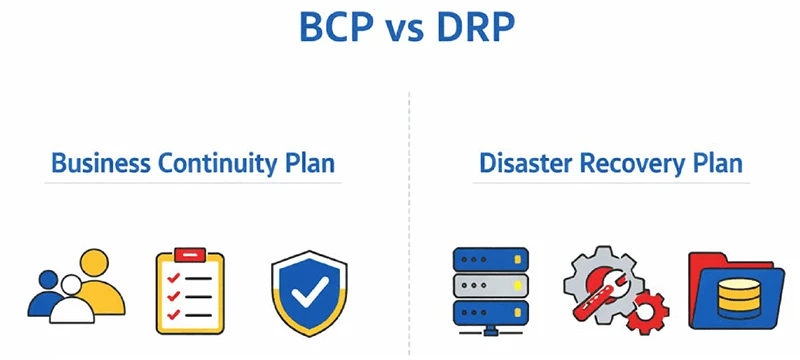
A business continuity plan (BCP) is designed to keep essential business functions operating during disruption. It addresses how the organization maintains service delivery, communication, and operational stability when normal conditions are interrupted.

A disaster recovery plan (DRP), by contrast, concentrates on restoring IT infrastructure, applications, and data after a failure or cyberattack. Its priority is the technical recovery of systems that support the business.

BCP keeps business operations running during disruption.
DRP restores the systems and data that enable those operations.

Both are critical — but they are not interchangeable.

Side-by-side comparison: BCP vs. DRP

The table below summarizes the difference between a business continuity plan and a disaster recovery plan in practical terms.

Category Business Continuity Plan Disaster Recovery Plan
Primary objective Maintain critical business operations Restore systems and data
Scope Organization-wide IT-specific
Focus People, processes, services Infrastructure, networks, applications
Activation timing Immediately at disruption During or after system failure
Key stakeholders Executives, crisis management teams IT, security, network recovery teams
Core method Business impact analysis Technical recovery procedures
Example Temporary service workaround Network recovery plan

This comparison highlights that the difference between BCP and DRP is structural — not just semantic.

Where Business Continuity ends, and Disaster Recovery begins

In real incidents, boundaries become clearer.

If a cyberattack disrupts access to systems:

  • The business continuity plan ensures that customers are informed, alternative workflows are activated, and critical operations continue where possible.
  • The disaster recovery plan defines how systems and data are restored, how infrastructure is rebuilt, and how network recovery plans are executed.

Business continuity disaster recovery strategy requires coordination between these layers. One protects business functions; the other rebuilds the technical foundation.

Without DRP, systems may remain down.
Without BCP, restored systems may not immediately translate into operational stability.

Key strategic difference between a Business Continuity Plan and a Disaster Recovery Plan

1. Scope and ownership

BCP is cross-functional. It involves leadership, operations, crisis management, emergency preparedness managers, and sometimes emergency management directors.

DRP is primarily technical. It is owned by IT teams, infrastructure engineers, and security specialists responsible for systems data restoration.

2. Type of risk addressed

BCP addresses broader business continuity disaster scenarios, including:

  • Facility access issues
  • Supply chain disruptions
  • Workforce unavailability
  • Crisis management needs

DRP addresses technical failures such as:

  • Data center outages
  • System failures
  • Network disruptions
  • Cyber attacks

3. Measurement of success

BCP success is measured by the continuity of critical business functions.

DRP success is measured by recovery time, system restoration, and minimized downtime.

4. Tools and analysis

BCP relies heavily on business impact analysis, identifying which business operations are most critical.

DRP relies on technical recovery plans, including backup strategies, system replication, and infrastructure restoration procedures.

When companies use BCP and DRP separately

In some cases, organizations develop these plans independently.

Smaller companies may:

  • Outsource disaster recovery
  • Maintain basic recovery plans but limited continuity documentation
  • Focus on compliance-driven disaster recovery plans only

In regulated industries, disaster recovery compliance requirements may exist without a fully integrated continuity strategy.

Similarly, some organizations invest heavily in business continuity plans — including crisis management plans and communication frameworks — but underinvest in technical recovery depth.

While these approaches may satisfy minimum requirements, they create blind spots.

How BCP and DRP work together in practice

Most real-world incidents activate both plans.

For example:

– Cyberattack scenario

A ransomware attack encrypts systems.

  • DRP activates to restore infrastructure and systems data.
  • BCP activates to maintain customer communication and business operations during recovery.

– Data center failure

A major outage disrupts infrastructure.

  • Disaster recovery plan initiates technical failover.
  • Business continuity ensures operational adjustments and service continuity.

Hybrid multicloud incident

A cloud region fails.

  • DRP handles workload recovery and system restoration.
  • BCP manages operational continuity across departments.

In practice, business continuity disaster recovery alignment ensures that recovery efforts support operational stability.

Why confusing business continuity plan and DRP creates risk

Organizations that misunderstand the difference between a business continuity plan and a disaster recovery plan often face one of two problems:

  1. Strong disaster recovery, weak operational coordination
  2. Well-documented continuity plans, but insufficient technical recovery depth

Both scenarios increase risk.

Restoring systems without business coordination can delay service resumption.
Maintaining operations without technical recovery capability can prolong outages.

Effective disaster recovery business continuity requires clarity in responsibilities and integration between both strategies.

Summing up

The difference between a business continuity plan and a disaster recovery plan lies in scope, focus, and execution.

  • Business continuity protects business functions.
  • Disaster recovery restores systems and data.

They are not competing strategies. They are complementary layers of resilience.

Organizations that clearly define and align BCP and DRP are better equipped to manage crisis, protect critical operations, minimize downtime, and ensure long-term stability.

Understanding this difference is not theoretical — it directly influences how effectively a company responds when disruption inevitably occurs.

Enter your email to be notified about new and relevant content.

Thank you for joining us!

We hope you'll find it usefull.

You can unsubscribe from these communications at any time. Privacy Policy

News & Reports

FinOps and MLOps

A full description of OptScale as a FinOps and MLOps open source platform to optimize cloud workload performance and infrastructure cost. Cloud cost optimization, VM rightsizing, PaaS instrumentation, S3 duplicate finder, RI/SP usage, anomaly detection, + AI developer tools for optimal cloud utilization.

FinOps, cloud cost optimization and security

Discover our best practices: 

  • How to release Elastic IPs on Amazon EC2
  • Detect incorrectly stopped MS Azure VMs
  • Reduce your AWS bill by eliminating orphaned and unused disk snapshots
  • And much more deep insights

Optimize RI/SP usage for ML/AI teams with OptScale

Find out how to:

  • see RI/SP coverage
  • get recommendations for optimal RI/SP usage
  • enhance RI/SP utilization by ML/AI teams with OptScale